
AI is quickly reshaping SaaS — but the real question is where it actually delivers operational value.
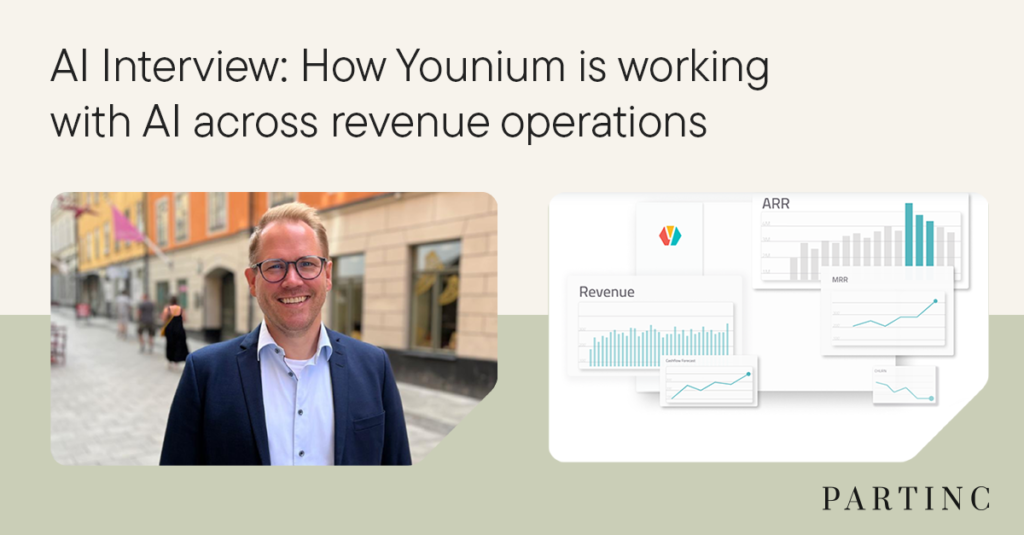
In our ongoing interview series, we now highlight our portfolio company Younium. We asked their Founder and CEO, Niclas Lilja, how they are incorporating AI into their offering, processes, and daily operations. Here are his answers:
1. How does Younium approach AI?
We’re building Younium as a Revenue Operating System for software companies — one platform covering the full revenue lifecycle from quote to cash to ledger. That depth shapes how we think about AI. Most ”AI in SaaS” announcements are a thin layer bolted onto a single workflow.
The opportunity for us is different: because Younium already sits on the contracts, usage, billing, and revenue data of our customers, AI inside the platform has the context it needs to do actual work — not just generate text or query data.
2. How are you working to include AI in your offering?
We treat AI features the same way we treat every feature: they have to remove real operator pain, not just demo well. Today, the most concrete value sits across:
Order migration, data quality, ease of use e.g., AI-powered contract import, anomaly detection in data.
Repetitive work that eats a lot of time from our customers’ day-to-day work – We’re bringing agents that will drive renewals, billing, dunning, to name a few, and where we see 80% time reductions already in piloting.
An emerging set of AI capabilities that operate inside the revenue lifecycle and across the full revenue layer — price optimization, churn prevention, deal governance, etc.
Our differentiator is data scope. A point-solution AI billing assistant only sees billing. Younium sees contract, usage, billing, revenue, and renewal as one model. That makes the answers AI can produce on top of it materially better — and it’s a moat that gets harder for narrower tools to copy.
3. How do you use AI in your product development and internal processes?
Inside the company, AI has moved from experimental to default in several areas: Engineering. AI coding assistants are part of every engineer’s daily stack. We’re seeing real lift in development velocity and review quality, error handling has been more or less automated and AI-augmented testing and code review are becoming standard practice rather than novelty.
Customer-facing operations. e.g., AI summarisation in support, AI-assisted onboarding, CS draft generation, and root cause analysis of errors. The pattern is consistent: AI doesn’t replace the operator, it strips out boilerplate so the operator spends their time on judgment.
Sales and marketing. E.g. AI is used to run automatic tiering and classification of prospect data, analysis on the customer journey and real-time SEO optimization.
4. How do you work to integrate AI into your everyday work?
Day-to-day, culture matters as much as tooling. AI tools are available company-wide, and we actively encourage their use for drafting, research, summarisation, and meeting prep.
Three principles guide adoption:
- Outcome before tool. We don’t deploy AI to be able to say we have AI. We want to prove a hypothesis or discard it.
- Operator judgment stays in the loop. For anything customer-facing or financial, AI proposes, a human approves.
- Compound, don’t sprint. Small AI wins applied across the team every week beat one flashy launch.
5. Where is this heading?
Subscription billing and revenue management is one of the highest-leverage places in a software company for AI to do real work — the data is structured, the workflows are repetitive, and the cost of error is concrete. Over the next twelve months we expect AI to move from feature to fabric inside Younium: not a separate ”AI module,” but the default way every workflow runs.
That’s why we believe a Revenue Operating System is one of the most natural homes for AI to actually deliver, leaving the hype behind.
For more information, please visit Younium.com
Stay tuned! In the coming weeks, we’ll share another story from our portfolio of SaaS companies leveraging AI to deliver real value.